Passport Photo Size in Pakistan: Complete Specifications Guide
A definitive guide to official Pakistani passport photo requirements. Covers exact millimeter measurements, 300 DPI pixel dimensions, white background rules, NADRA CNIC standards, and online renewal upload guidelines.

Whether you are applying for a brand-new Pakistani Machine Readable Passport (MRP), renewing an e-Passport through the Directorate General of Immigration & Passports (DGIP) online portal (onlinemrp.dgip.gov.pk), or updating your National Identity Card (Smart CNIC / NICOP) at a NADRA Registration Center, submitting an improperly formatted photograph is the single leading reason for application delay or outright rejection.
Historically, passport studios across Karachi, Lahore, Rawalpindi, and Peshawar produced photos with sky blue backgrounds. However, international civil aviation reforms (ICAO Doc 9303 compliance) and the rollout of automated biometric e-Passports have introduced strict standardized guidelines. Today, biometric passport capture requires pristine white or light off-white backgrounds, precise crown-to-chin proportions, and rigid facial boundary rules.
In this authoritative guide, we provide the official technical criteria enforced by Pakistani passport authorities, outline the mathematical pixel conversions for digital uploads, discuss religious headwear guidelines, and demonstrate how you can create, crop, and generate a printable 300 DPI passport sheet at home using Pagla Tool's free client-side maker.
Official Pakistani Passport Photo Dimensions Summary
The official specifications mandated by the Directorate General of Immigration & Passports (Ministry of Interior, Government of Pakistan) are:
- Physical Dimensions: 35 mm × 45 mm (3.5 cm width × 4.5 cm height / approx. 1.38 × 1.77 inches).
- Digital Pixel Dimensions (at 300 DPI): 413 pixels width × 531 pixels height.
- Digital Pixel Dimensions (at 600 DPI): 827 pixels width × 1063 pixels height.
- Facial Height (Crown to Chin): 31 mm to 36 mm (occupying 70% to 80% of total vertical canvas).
- Margin Above Hairline: 3 mm to 5 mm of visible background above the top of the head.
- Color Palette: Full 24-bit TrueColor (RGB). Black-and-white photos are strictly rejected.
- Photo Recency: Taken within the last 6 months to reflect the applicant's current appearance.
The ICAO Doc 9303 Compliance Standard Explained
Pakistan is a member state of the International Civil Aviation Organization (ICAO). All Pakistani Machine Readable Passports (MRPs) and newly deployed chip-embedded e-Passports are engineered according to ICAO Document 9303 Section 3 ("Specifications Common to all Machine Readable Travel Documents").
ICAO Doc 9303 establishes global biometric standards for automated facial recognition at border e-Gates (such as Smart Gates at Dubai International Airport, London Heathrow, or Islamabad International Airport). When your passport chip is read at an international immigration barrier, the embedded JPEG image stored on the cryptographic RFID chip is matched against your live face using an automated Euclidean biometric algorithm.
For this matching to succeed in under 800 milliseconds, the algorithm relies on specific landmarks: the distance between your inner and outer eye corners (canthi), the vertical distance from the subnasale (base of the nose) to the menton (base of the chin), and the symmetry of your zygomatic arches (cheekbones). Any improper head rotation, heavy makeup filter, or uneven shadow throws off these calculations, causing the automated gate to reject the passport and refer the traveler to manual inspection.

Figure 1: Official millimeter measurements and facial bounding boxes for Pakistani passport photos.
Comprehensive Matrix: DGIP Passport vs NADRA vs Visa Photos
Many Pakistani citizens confuse the photo requirements for domestic identity documents with international travel standards. Here is an authoritative comparative matrix:
| Document Type / Agency | Prescribed Dimensions | Background Color | Print Resolution | Key Requirements & Verification Rules |
|---|---|---|---|---|
| Pakistani Machine Readable Passport (MRP / e-Passport) | 35 mm × 45 mm | Plain White (Pure hex #FFFFFF) | 300 DPI to 600 DPI | Both ears visible; eyes looking straight into the lens; mouth closed. Frontal lighting. |
| NADRA Smart CNIC / NICOP / POC | Live Biometric Capture at Desk (or 35 × 45 mm upload online) | Light Grey or White | 300 DPI | Facial contours from forehead to jawline fully visible; no heavy skin retouching or filters. |
| NADRA CRC / Child B-Form (Under 18) | 35 mm × 45 mm (or 1.5 × 2 inch) | White background | 300 DPI | Eyes open, neutral expression; no pacifiers, toys, or parent hands visible in frame. |
| Pakistani Driving License (Punjab, Sindh, Islamabad) | 35 mm × 45 mm (or 1.5 × 2 inch) | White or Sky Blue | 300 DPI | Formal or semi-formal clothing; no sunglasses or tinted shades; level shoulders. |
| US Visa (B1/B2, F1 Student) from Pakistan | 2 × 2 inch (51 × 51 mm / 600 × 600 px) | Pure White | 300 DPI | Eyeglasses strictly banned; head must be between 1 inch and 1 3/8 inches from chin to crown. |
| UAE Tourist / Employment Visa from Pakistan | 43 mm × 55 mm or 35 × 45 mm | Plain White | 300 DPI | Frontal view, high contrast, clean white background without shadows. |
| Schengen Tourist & Business Visa (from Pakistan) | 35 mm × 45 mm | Light Grey or White | 300 DPI | Strict 70-80% face height (32-36 mm); ears and hairline clearly uncovered. |
Facial Proportion Geometry: Crown-to-Chin Measurements
The most critical geometric requirement of ICAO-compliant passport photos is the facial proportion rule. In a standard 45 mm high print:
The vertical distance measured from the lowest point of your chin to the highest point of your head (the top of your skull, excluding high-volume hairstyles) must measure between 31 mm (68.8%) and 36 mm (80.0%).
If your head is framed too small (e.g. 20 mm high), the biometric scanning scanner cannot resolve sufficient feature points across your nasal bridge and pupils. If your head is framed too large (e.g. 40 mm high), your chin or forehead will be clipped when the passport printer applies physical borders.
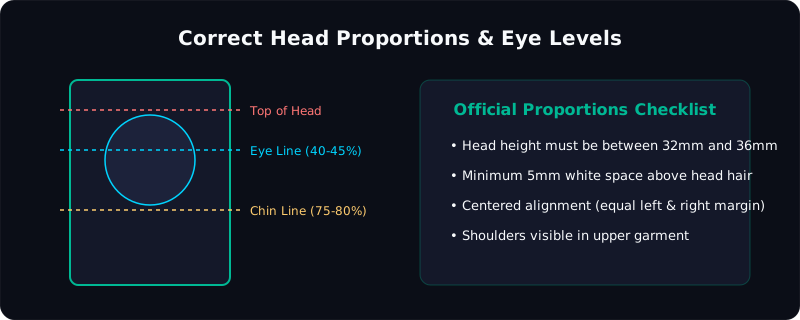
Figure 2: Eye-line horizontal positioning and 75% facial bounding box rules.
Child, Minor, and Infant Passport Photo Guidelines
Photographing newborn babies, toddlers, and young children for Pakistani passport issuance or NADRA Child Registration Certificates (B-Form) requires special patience and care:
- Children Under 5 Years: Passport authorities allow a relaxed facial expression requirement. Toddlers are not expected to maintain a completely neutral expression, and slight head movement is tolerated.
- Babies Under 1 Year: Lay the infant flat on their back on a clean, smooth, plain white sheet or uncreased white blanket. Photograph from directly above, ensuring no parent hands, support pillows, toys, pacifiers, or feeding bottles are visible inside the frame.
- Both Eyes Must Be Open: For children over 1 year of age, both eyes must be open and facing forward toward the camera lens. Wait until the child is alert and calm after a feeding before taking the picture.
The White vs Sky Blue Background Dilemma Clarified
One of the most frequent points of confusion among Pakistani applicants is: "Should my passport photo have a white background or a sky blue background?"
Here is the official policy clarification:
- Physical Passport Offices (RPO / Executive Passport Offices): When applying in person at a passport office in Pakistan or at a Pakistani Embassy abroad, your photograph is taken live at the physical counter using their integrated biometric camera system against their official backdrop.
-
Online MRP Portal (DGIP Renewal): When uploading a photograph online to renew your passport via
onlinemrp.dgip.gov.pk, the portal specification requires a pure white background. Uploading an old photo with a sky blue background triggers an automated color histogram flag: "Background color does not meet white standard." - NADRA CNIC Physical Walk-In: NADRA centers capture photos live at their booths against official grey/white screens. For overseas online NICOP applications, plain white is mandatory.
Conclusion: For any digital photo upload to Pakistani immigration or identity portals, always use a pure, shadow-free white background.
Technical Specifications for Online MRP Portal Uploads
If you are renewing your passport via Pakistan's online portal, the web validator enforces specific binary file criteria:
- File Format: JPEG or JPG only. PNG, WebP, and TIFF files are rejected.
- File Size Cap: Maximum file size must not exceed 1.0 MB (Optimal target: 100 KB to 200 KB).
- Pixel Dimensions: Minimum 600 × 600 pixels, or 413 × 531 pixels (35 × 45 mm at 300 DPI).
- Color Mode: RGB 24-bit TrueColor. Grayscale or CMYK color spaces will fail validation.
- Lighting & Contrast: No red-eye, no reflections on spectacle lenses, and zero drop shadows behind the ears or neck.
Dress Code, Hijab, Turban, and Eyeglasses Directives
Pakistani passport guidelines accommodate cultural and religious headwear while strictly adhering to international biometric security protocols:
Religious Headwear (Hijab, Dupatta, Turban): Head coverings worn for religious reasons are permitted. However, the covering must sit back far enough to leave the entire facial oval visible from the tip of the chin to the top of the forehead. Both cheekbones and the jawline must remain completely uncovered. No shadow from the fabric may fall across the face.
Neqab / Face Veil: For biometric photo capture, full face veils must be temporarily removed so that the complete face can be recorded.
Clothing Contrast: Wear dark, solid-colored clothing (navy blue, dark gray, black, burgundy, or dark green). Because the background is pure white, wearing a white shirt or light cream shalwar kameez causes your shoulders to blend into the background, making it impossible for edge-detection scanners to identify your posture.
Prescription Glasses: DGIP strongly recommends removing eyeglasses for the photograph. If worn, frames must be thin, non-reflective, and must never obscure any part of the pupils or irises. Tinted lenses or sunglasses are strictly prohibited.
Step-by-Step: Making a Pakistani Passport Photo at Home
You do not need to visit a photo studio to get a compliant passport photo. With Pagla Tool, you can generate compliant prints right from your home:
Step 1: Capture Your Portrait in Natural Daylight
Stand 3 to 4 feet in front of a white wall facing an open window during daytime. Have a family member hold the phone at eye level roughly 5 to 6 feet away. Use the 2x optical zoom to prevent facial distortion. Keep a neutral expression with your mouth closed and eyes looking directly into the camera lens.
Step 2: Open Pagla Tool's Passport Photo Maker
Navigate to our Passport Size Photo Maker. Select the "3.5 × 4.5 cm (Pakistan / India / UK)" preset button.
Step 3: Frame and Align with Visual Guidelines
Use our interactive drag, zoom, and crop canvas to position your head within the oval guidelines. Ensure your chin rests on the lower reference line and the top of your hair aligns with the upper reference marker.
Step 4: Enable Pure White Background Fill
Check the "Pure White Background Fill" option. This cleans up minor wall discolorations, ensuring 100% compliance with DGIP and ICAO standards.
Step 5: Download Single Photo or Multi-Photo Print Sheet
Download your single 35 × 45 mm digital photo (at 300 DPI) for immediate online upload to onlinemrp.dgip.gov.pk. If you need physical prints for a visa appointment or university admission, click "Download 4×6 Print Sheet (8 Photos)" or "Download A4 Sheet (30 Photos)" and print it on high-gloss photo paper at any local copy shop!
Create your Pakistani passport photo in 60 seconds
Accurate 35 × 45 mm presets, 300 DPI export, white background fill, and multi-photo print sheets for A4 and 4×6 photo paper. 100% private in your browser.
Open Passport Size Photo MakerTop 7 Reasons Photos Are Rejected by Passport Offices in Pakistan
DGIP case officers and automated web validators reject applications due to these seven frequent mistakes:
- Incorrect Background Hue: Using an off-white, yellowed, or sky blue background for digital portal renewal.
- Selfies with Wide-Angle Barrel Distortion: Taking a selfie from 18 inches away inflates the nose, curves the ears backward, and shifts facial feature ratios outside biometric tolerances.
- Smiling or Open Mouth: Showing teeth or smirking alters the distance between lip corners and the jawline, violating ICAO neutral expression rules.
- Hair Obscuring Eyes or Eyebrows: Long bangs or stray strands of hair crossing the pupils or concealing the eyebrow arches prevent facial recognition scanners from mapping ocular landmarks.
- Head Tilt and Shoulder Angle: Tilting the head even 5 degrees left or right, or turning the body into a three-quarter glamour pose. Both shoulders must be square and level.
- Flash Reflections on Glasses: White glare spots reflecting off spectacle lenses that hide the iris.
- Heavy Beauty Filters and Digital Retouching: Using smartphone smoothing filters that eliminate skin pores, moles, and natural contours. Biometric verification requires authentic physical texture.
Frequently Asked Questions (FAQ)
What is the exact passport photo size in Pakistan in cm and mm?
Can I use a blue background for Pakistani passport renewal?
onlinemrp.dgip.gov.pk) strictly require a plain white background.
Are women allowed to wear a hijab or dupatta in passport photos?
Can I print passport photos at home using an ordinary printer?
Does Pagla Tool upload my private passport photo to any server?
Conclusion & Helpful Resources
Obtaining an official passport photo in Pakistan is easy and free once you know the exact specifications: 35 × 45 mm dimensions, 300 DPI resolution, 70% to 80% facial height coverage, and a shadow-free pure white background. By adhering strictly to these directives, your physical passport appointment or online MRP renewal will process smoothly without administrative delays.
Explore our other document preparation tools and tutorials: