Passport Photo Size in India and Requirements (MEA & PSK Guide)
The complete handbook on Indian passport photo sizes. Discover the exact 35×45 mm and 2×2 inch rules enforced by the Ministry of External Affairs (MEA), Passport Seva Kendra (PSK) live capture procedures, and minor photo guidelines.

Applying for an Indian Passport through the Passport Seva system—whether under the Normal scheme, Tatkaal category, or re-issuance due to exhaustion of visa pages—is one of the most rigorously scrutinized bureaucratic procedures in the country. Governed by the Ministry of External Affairs (MEA) and executed across hundreds of Passport Seva Kendras (PSKs) and Post Office Passport Seva Kendras (POPSKs), document scrutiny leaves zero margin for photographic error.
While adult citizens appearing in person at a PSK have their digital biometric photograph captured live at Counter A by an official camera operator, millions of applicants still require physical printed photos or digital uploads. Applicants filing for infants and children under 4 years of age, citizens applying through Indian Embassies and Consulates abroad (via the Global Passport Seva Project / GPSP), applicants filing for Overseas Citizenship of India (OCI) cards, and candidates submitting annexures must bring pristine physical prints meeting strict international biometric guidelines.
Submitting a photograph with a creamy background, a dark white shirt that bleeds into the white wall, improper head framing, or spectacle reflections leads to instant rejection at the document verification counter. In this definitive guide, we break down the official MEA photo criteria, contrast the domestic 35×45 mm specification against the 2×2 inch OCI/visa format, explain infant photography procedures, and show you how to generate 300 DPI passport photos using Pagla Tool.
Official MEA Indian Passport Photo Dimensions
The Ministry of External Affairs, Government of India, enforces precise physical and digital standards formulated in accordance with the International Civil Aviation Organization (ICAO Doc 9303):
- Physical Print Dimensions: 35 mm × 45 mm (3.5 cm width × 4.5 cm height / 1.38 × 1.77 inches).
- Digital Resolution (300 DPI): 413 pixels width × 531 pixels height.
- High-Definition Print Resolution (600 DPI): 827 pixels width × 1063 pixels height.
- Head Height Ratio: The distance between the base of the chin and the top of the skull must measure between 31 mm and 36 mm (occupying 70% to 80% of total vertical canvas).
- Top Margin: A minimum clearance of 3 mm to 5 mm must exist between the top of the hair and the upper border of the print.
- Background Color: Plain, solid, pure white. No patterns, textures, shadows, or colored backdrops are allowed.
- Paper Type: Printed on premium, continuous-tone semi-matte or high-gloss photographic paper with zero creases.
The NIC Biometric Matching Architecture
When photographs are captured or scanned at a Passport Seva Kendra, they are transmitted through encrypted government channels to the National Informatics Centre (NIC) central data repository in New Delhi.
At the central repository, automated facial comparison software executes 1-to-N matching against the national criminal database, prior passport records, and international Interpol watchlists. The facial recognition engine extracts 80 discrete facial points—including the nose bridge width, eye socket depth, and mandibular jaw curve.
For these mathematical vectors to compute reliably, the photograph must feature completely flat, uniform lighting. If an applicant has a shadow cast under their chin or behind one ear, the feature extraction algorithm miscalculates the depth coordinate, generating a false biometric match alert or triggering an administrative holdup during police verification.

Figure 1: Domestic MEA 35×45 mm passport standard compared with the overseas 51×51 mm (2×2 inch) OCI format.
Comparison Matrix: Indian Passport vs OCI vs Visa Specs
Depending on whether you are applying for a regular Indian passport inside India, an OCI card through an Indian Embassy abroad, or a foreign travel visa, dimensions vary substantially:
| Document / Application Category | Prescribed Dimensions | Pixel Resolution (300 DPI) | Background Requirement | Key Verification Rule |
|---|---|---|---|---|
| Indian Passport (Domestic MEA / PSK) | 35 mm × 45 mm (3.5 × 4.5 cm) | 413 × 531 px | Solid White (#FFFFFF) | 70-80% face coverage; dark attire; ears visible; no glasses. |
| Overseas Citizenship of India (OCI Card) | 51 mm × 51 mm (2 × 2 inch square) | 600 × 600 px | Pure White | Head between 1 inch and 1 3/8 inches; square 1:1 aspect ratio. |
| Pan Card (UTIITSL / NSDL - India) | 25 mm × 35 mm (approx.) | 213 × 213 px (under 30KB) | White or Light Background | Signatures must be strictly 400 × 200 px under 10KB. |
| Indian e-Visa (Foreigners Visiting India) | Min: 350 × 350 px Max: 1000 × 1000 px |
Square Aspect Ratio (1:1) | Plain White or Light | Size between 10 KB and 1 MB; face centered without border. |
| Schengen Visa (from India) | 35 mm × 45 mm | 413 × 531 px | Light Grey or White | Strict biometric 32 to 36 mm head height; neutral expression. |
| US Visa (DS-160 from India) | 2 × 2 inch (51 × 51 mm) | 600 × 600 px | Pure White | Spectacles strictly forbidden; full face front view. |
Facial Geometry: The 70% to 80% Crown-to-Chin Rule
The single most common cause of photographic disqualification at Indian passport scrutiny counters is improper facial scaling. MEA guidelines dictate that your face must occupy between 70% and 80% of the vertical canvas height.
In a physical 45 mm print:
- Minimum Facial Height: 31.5 mm (from lower tip of the chin to top of skull).
- Maximum Facial Height: 36.0 mm.
- Horizontal Eye-Line Positioning: The midpoint between both pupils should sit between 28 mm and 32 mm above the bottom border of the photo.
If an applicant crops the photo too loosely (e.g. including the entire chest down to the mid-torso), the facial area drops below 50%, making biometric point extraction impossible. Conversely, cropping too tightly around the chin and forehead leads to immediate rejection by the passport verification software.
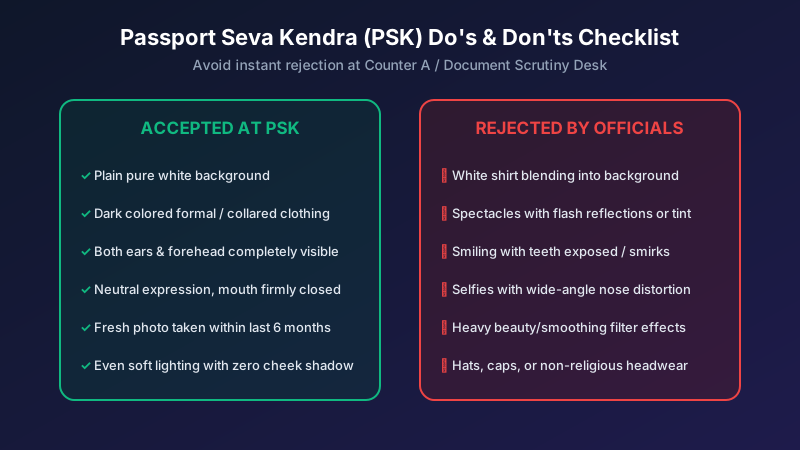
Figure 2: Visual compliance criteria enforced at Counter A during Passport Seva Kendra document verification.
PSK Counter A Live Biometrics vs Who Needs Physical Photos
A widespread misconception among adult passport applicants in India is: "Do I need to carry physical passport photos to my PSK appointment?"
Here is how the modern Passport Seva workflow operates:
- Adult Applicants (Ages 4 and above): When you arrive at your scheduled PSK appointment and clear Counter Pre-Check, you proceed to Counter A (TCS Operational Counter). The Counter A officer uses a high-resolution digital biometric camera mounted on their terminal desk to capture your live photograph against a motorized white background screen. Your fingerprints and digital signature are captured simultaneously. Adult applicants do NOT need physical photos for regular in-person PSK appointments.
- Minors and Infants Under 4 Years: Because children under four cannot reliably sit still, look directly into the camera lens, and hold a neutral expression, the live camera system at Counter A is bypassed. Parents must bring two physical printed passport photos (35 × 45 mm) on high-quality photo paper with a plain white background.
- Camp PSK / Mobile Seva Vans: Temporary outreach camps without high-end studio lighting often require applicants to carry two standard physical passport prints.
- Overseas Indian Missions (Embassies & Consulates): Indian citizens renewing their passports in Dubai, London, New York, or Singapore must attach physical prints matching embassy specifications.
Tatkaal Passport Applications & Annexures
Under the Tatkaal scheme (urgent dispatch within 1 to 3 business days), document scrutiny is conducted under expedited timelines. Verification officers at Counter B and Counter C check every submitted Annexure (such as Annexure E - standard affidavit of citizenship) against the applicant's physical biometric records.
If you are submitting physical forms or Tatkaal verification packages for an infant or minor child, ensure that the photograph attached to Annexure D or Annexure C matches the spare photograph handed to Counter A. Submitting mismatched prints from different photo shoots causes the Tatkaal application to be downgraded to Normal processing, delaying issuance by up to two weeks.
Children & Infants Under 4 Years: Special Rules
Photographing an infant or toddler for an Indian passport requires following specialized MEA dispensations:
- White Background Without Supports: Lay the infant on a plain white bedsheet without wrinkles, or place them in a car seat draped completely in a solid white cloth. No parent's hands, arms, supporting pillows, toys, or pacifiers may be visible inside the frame.
- Face Direction: The baby's head must be facing the camera lens. While newborns are not expected to hold a rigid neutral expression, both eyes must be open and facing forward.
- Mouth Position: Toddlers under one year of age with slightly open mouths are acceptable, but older children should have their mouths closed.
- Both Ears Visible: Ensure the baby's hair does not cover the ears or fall across the eyes.
Dress Code, Turbans, Hijabs, and Spectacles Directives
The Indian government enforces culturally inclusive yet biometric-rigorous guidelines regarding personal appearance:
Religious Head Coverings (Turban, Pagri, Hijab): Turbans and religious headscarves are fully permitted. However, the headwear must not obscure any portion of the candidate's facial oval. The forehead (from the hairline down), eyebrows, eyes, nose, cheeks, and chin must be 100% visible. The headwear must not cast dark shadows across the upper face.
Clothing Contrast Rule: Never wear a white shirt, white kurta, or light cream top. Because the background is pure solid white, white clothing creates an optical illusion where the applicant's neck and shoulders blend invisibly into the backdrop, triggering an automated boundary detection error. Wear dark, contrasting colors such as dark blue, black, maroon, bottle green, or charcoal gray.
Spectacles & Eyeglasses: While thin prescription glasses were previously permitted, MEA guidelines now strongly recommend removing eyeglasses entirely. Lens glare, anti-reflective coatings that reflect blue or green flash hotspots, and thick frames that obscure the outer corners of the eyelids violate automated biometric standards. Tinted shades or sunglasses are strictly prohibited.
Step-by-Step: Making an Indian Passport Photo with Pagla Tool
Creating compliant prints for minors, OCI applications, or overseas consular submissions at home takes less than two minutes:
Step 1: Capture Your Portrait Using Soft Daylight
Stand 3 to 4 feet in front of an off-white wall facing an open window. Have someone take your portrait using your smartphone from 5 to 6 feet away using 2x optical zoom. Keep your shoulders square, eyes level, and mouth closed.
Step 2: Launch Pagla Tool's Passport Photo Maker
Open our Passport Size Photo Maker. Select the "3.5 × 4.5 cm (India / Pakistan / UK)" preset button. For OCI or US visa applications, select "2 × 2 inch".
Step 3: Align Head Within the Biometric Guides
Adjust the zoom and pan controls until your chin rests comfortably on the lower marker and the crown of your head touches the upper guide line, satisfying the 75% facial coverage rule.
Step 4: Enable Pure White Background Fill
Check the "Pure White Background Fill" toggle. This neutralizes subtle wall shadows or off-white paint casts, ensuring full compliance with MEA standards.
Step 5: Download Single Photo or Multi-Print Sheet
Download your single 300 DPI high-resolution JPEG for digital submissions. If you need physical prints for a minor at the PSK, download the "4×6 Print Sheet (8 Photos)" or "A4 Sheet (30 Photos)" and print it on glossy photo paper at any local printing center for under ₹30!
Generate Indian passport photos in seconds
Official 3.5 × 4.5 cm and 2 × 2 inch presets, 300 DPI export, white background fill, and multi-photo print sheets for A4 and 4×6 photo paper. 100% private in your browser.
Open Passport Size Photo MakerTop 7 Photo Rejection Pitfalls at Passport Seva Kendras
Verify your photographs against this checklist to ensure smooth clearance at Counter A:
- Wearing White Clothing: Shoulders dissolving into the white background causes automated contour clipping failures.
- Reflective Glare on Eyeglasses: Flash spots on spectacles that cover the pupils or iris edges.
- Selfie Distortion: Close-up smartphone lenses causing wide-angle nose bulbousness and hidden ears.
- Hair Covering Forehead or Eyes: Bangs or long fringes that conceal the eyebrow ridges.
- Tinted or Creased Backgrounds: Using off-white, beige, or wrinkled bedsheet backdrops.
- Teeth Showing / Expressive Faces: Grinning, smirking, or frowning. A strictly neutral facial expression is required.
- Low DPI Pixelation: Printing low-resolution 72 DPI WhatsApp images on physical paper, resulting in visible jagged dots.
Frequently Asked Questions (FAQ)
Do adult applicants need to carry passport photos to Passport Seva Kendra?
What is the exact passport photo size in India in cm, mm, and inches?
What photo size is required for an OCI (Overseas Citizen of India) card?
Can I wear glasses in an Indian passport photo?
Is my photograph uploaded to any server when using Pagla Tool?
Summary & Related Application Tools
Securing a compliant passport photo in India comes down to three rules: solid white background, dark contrasting formal attire, and 70% to 80% facial coverage from chin to crown. Whether generating physical prints for an infant's PSK appointment or prepping digital files for an OCI application, Pagla Tool gives you studio-grade results in seconds.
Check out our related document utilities: