Scholarship Application: Photo and Document Checklist (Erasmus, Fulbright & HEC)
Ensure your life-changing international scholarship application never gets disqualified for clerical errors. Learn exact photo standards, multi-stage degree attestation, and client-side PDF dossier compilation.

Table of Contents
- 1. The Stakes of Clerical Precision: Why Stellar Candidates Get Disqualified
- 2. Biometric Photo Standards: Fulbright (2×2 in) vs Erasmus Mundus (35×45 mm)
- 3. The Multi-Tier Degree Attestation Pipeline (Board → HEC/IBCC → MOFA → Apostille)
- 4. The "Both Sides" Rule: Why Missing the Stamp Reverse Invalidates Your Degree
- 5. Detailed Marks Certificates (DMC) and Official Grading Scale Equivalency
- 6. Europass CV, Motivation Letter & Font Integrity Rules
- 7. Letters of Recommendation (LoR): Letterheads, Seals & Verification Emails
- 8. Standardized Language Reports: IELTS TRF, TOEFL iBT & Duolingo Score Scans
- 9. Comprehensive International Scholarship Specifications Matrix
- 10. Step-by-Step Practical Dossier Compilation Using Pagla Tool
- 11. Frequently Asked Questions (FAQ)
- 12. Conclusion & Pre-Submission Scholarship Audit Checklist
1. The Stakes of Clerical Precision: Why Stellar Candidates Get Disqualified
Every year, tens of thousands of exceptionally talented students and young professionals across Pakistan, India, Bangladesh, and Nigeria pour months of intellectual energy into crafting powerful Statements of Purpose (SOP) and personal statements. They aim for prestigious, fully funded master's and doctoral awards such as the Erasmus Mundus Joint Masters (EMJM), the Fulbright Foreign Student Program (USEFP), the UK Chevening Scholarship, and the German DAAD Scholarship.
Yet, admission statistics reveal a harsh reality: between 25% and 35% of all submitted applications are rejected during preliminary administrative scrutiny—long before an academic evaluation committee ever reads a single paragraph of the applicant's research proposal. These rejections stem entirely from clerical non-compliance:
- Uploading low-resolution mobile photos of degrees with unreadable registrar serial numbers
- Failing to provide official reverse-side scans demonstrating Higher Education Commission (HEC) or Ministry of Foreign Affairs (MOFA) attestation
- Submitting photographs with non-compliant dimensions, incorrect background tones, or selfie barrel distortion
- Exceeding strict portal file upload limits (e.g. attempting to upload an uncompressed 25MB scanner file to a portal capped at 2MB)
- Uploading separate, unlinked image files when the portal explicitly mandated a consolidated, paginated A4 PDF dossier
In international scholarship selection, document presentation is treated as a direct reflection of an applicant's professional diligence and academic discipline. A disorganized, blurry, or fragmented document dossier instantly degrades the credibility of even a gold-medalist academic profile.
2. Biometric Photo Standards: Fulbright (2×2 in) vs Erasmus Mundus (35×45 mm)
A frequent stumbling block for candidates applying to programs across multiple continents is assuming that a "passport size photo" is a universal, interchangeable standard. Different funding bodies enforce strictly distinct physical and digital criteria:

The North American Standard: Fulbright & US Universities
The Fulbright Foreign Student Program is managed in cooperation with the United States Department of State. Consequently, its portal mandates strict compliance with US Visa / DS-160 photograph standards:
- Physical Dimensions: Exactly
2 × 2 inches (51 × 51 mm) - Digital Resolution:
600 × 600 pixelsat 300 DPI (Aspect ratio 1:1 square) - Background Color: Pure plain white (#FFFFFF) with zero texture or cast shadows
- Facial Framing: The head (from top of hair to bottom of chin) must occupy between 50% and 69% of the total vertical height
- Eyeglasses: Strictly prohibited. Eyeglasses must be removed completely regardless of medical prescription.
The European Standard: Erasmus Mundus, DAAD & Chevening
European programs follow the International Civil Aviation Organization (ICAO Doc 9303) biometric passport photograph standard:
- Physical Dimensions: Exactly
35 × 45 millimeters (3.5 × 4.5 cm) - Digital Resolution:
413 × 531 pixelsat 300 DPI (Aspect ratio 7:9 vertical rectangle) - Background Color: Solid white, off-white, or neutral light grey
- Facial Framing: The facial oval must measure between 32mm and 36mm, occupying 70% to 80% of vertical space.
Instant Crop with Pagla Tool
Rather than paying commercial studios twice for different cutouts, capture a single high-resolution portrait against an evenly lit wall. Open Pagla Tool Passport Photo Maker, select the 2×2 inch preset for your Fulbright submission, and subsequently select the 35×45 mm preset for your European submissions. Both outputs download in seconds with guaranteed compliance.
3. The Multi-Tier Degree Attestation Pipeline (Board → HEC/IBCC → MOFA → Apostille)
For candidates graduating from Pakistani and Indian educational institutions, foreign selection boards require rigorous proof that your degrees are authentic state-recognized qualifications rather than unaccredited diploma mill credentials. Navigating this bureaucratic pipeline requires systematic, sequential execution:
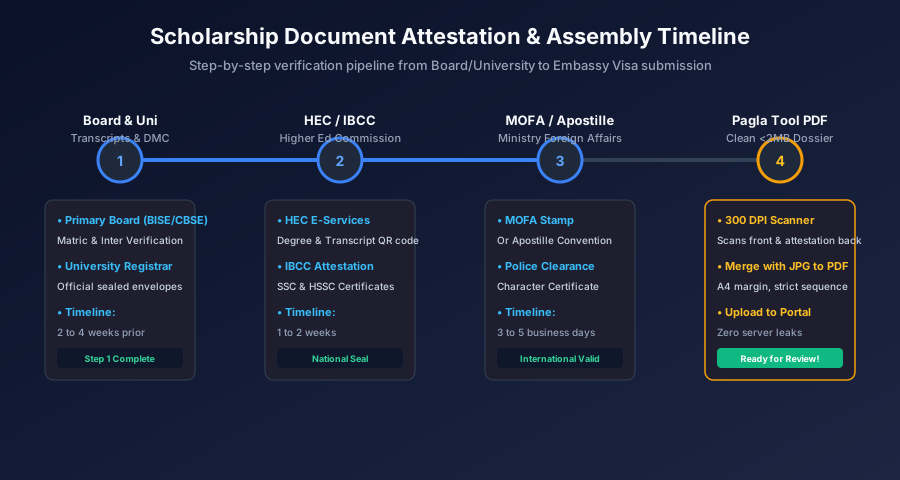
Tier 1: Secondary Education Attestation (BISE & IBCC)
Before higher commissions will touch your university diploma, your foundational secondary records must be authenticated. In Pakistan, original Matriculation (SSC) and Intermediate (HSSC) certificates must first be verified by their respective issuing Board of Intermediate and Secondary Education (BISE). Once sealed, they are submitted to the Inter Board Coordination Commission (IBCC) for security QR-code attestation stamps.
Tier 2: Higher Education Attestation (HEC E-Services)
For Bachelor's (16-year) and Master's (18-year) qualifications, the Higher Education Commission (HEC) is the apex certifying authority in Pakistan. Applicants must register on the HEC E-Services portal (eservices.hec.gov.pk), schedule an appointment, and submit both original degrees and Detailed Marks Certificates (DMCs). HEC affixes a unique tracking number, barcode, and embossed security seal.
Tier 3: Foreign Ministry Authentication (MOFA / Apostille)
Following the ratification of the Hague Apostille Convention by Pakistan in 2023, documents destined for member countries (including most European Union states) can receive an official Apostille Certificate issued by the Ministry of Foreign Affairs (MOFA). This eliminates the need for expensive secondary consular attestations at individual foreign embassies.
4. The "Both Sides" Rule: Why Missing the Stamp Reverse Invalidates Your Degree
The single most widespread administrative blunder in scholarship submissions is scanning only the front face of an educational degree. To a Western admission committee, an unauthenticated front face looks identical to a decorative novelty printout.
Why the Reverse Side Holds Legal Value
In South Asian educational administration, all legal authentication artifacts are stamped on the back of the parchment:
- The official HEC holographic sticker and registration stamp
- The IBCC security QR verification sticker
- The Ministry of Foreign Affairs (MOFA) fiscal ticket stamps and consular signature
- University Controller of Examinations verification register entries
When compiling your academic dossier, every degree certificate must be represented by two consecutive pages: Page 1 showing the front face, and Page 2 showing the complete, high-resolution scan of the authenticated reverse side.
5. Detailed Marks Certificates (DMC) and Official Grading Scale Equivalency
European and American admission officers frequently evaluate transcripts originating from dozens of diverse grading architectures (e.g. Pakistani 4.00 CGPA scales, Indian 10.0 CGPA percentage conversions, British First Class Honours classifications). To ensure your grades are evaluated fairly:
A. Official Controller of Examinations Transcripts Only
Never submit computer-generated student portal web printouts. Submit only official transcripts printed on anti-counterfeit watermark security paper bearing the embossed seal and handwritten signature of the Controller of Examinations.
B. Include the Transcript Legend Page
Almost all universities print an official Grading Scale Legend on the back of the transcript detailing credit hour definitions, letter grade thresholds (e.g., A = 80-100%, 4.00; B = 70-79%, 3.00), and cumulative grade point calculation formulas. Scanning and appending this legend page is mandatory; without it, European admission boards cannot calculate your equivalent European Credit Transfer and Accumulation System (ECTS) standing.
6. Europass CV, Motivation Letter & Font Integrity Rules
Selection committees review thousands of applicant CVs within strict review schedules. A poorly formatted resume created with complex graphics or non-standard fonts that fail to render on a reviewer's computer creates an immediate negative impression.
A. The Europass Format for European Scholarships
For Erasmus Mundus and DAAD programs, formatting your resume using the standardized Europass CV layout is strongly recommended. Europass standardizes work experience, language proficiency (CEFR levels A1 through C2), digital competencies, and research publications into a scannable, internationally recognized layout.
B. Motivation Letter Formatting & Typography
Ensure your Statement of Purpose adheres to rigorous academic typography standards:
- Standard Font Families: Use universal system fonts such as Arial, Calibri, Times New Roman, or Georgia. Avoid decorative or third-party web fonts that might substitute with distorted glyphs when rendered on a Linux or macOS reviewer machine.
- Font Sizing & Line Height: 11pt or 12pt body text with 1.15 to 1.5 line spacing. Keep margins at standard 1-inch (25.4 mm) bounds.
- Length Discipline: Strictly respect word counts (typically 500 to 1,000 words). Never exceed two A4 pages unless the prompt explicitly asks for an extended research synopsis.
7. Letters of Recommendation (LoR): Letterheads, Seals & Verification Emails
Letters of recommendation provide objective verification of your intellectual caliber, research maturity, and ethical character. Selection committees scrutinize recommendation letters for authenticity, immediately discarding generic or suspicious submissions:
Mandatory LoR Elements Checklist:
- Official Departmental Letterhead: The letter must be printed on official university or organizational stationary bearing the full institution logo, physical campus address, and official website URL.
- Referee Identity & Title: Full name of the professor or manager, department, academic rank (e.g. Associate Professor, Dean), and telephone contact.
- Official Institutional Email: The referee's contact email must use an official university domain (e.g.,
dr.ahmed@nust.edu.pkorprof.sharma@iitd.ac.in). Gmail, Yahoo, or Hotmail addresses are viewed with extreme suspicion by international selection panels and frequently trigger fraud audits. - Handwritten Signature & Official Rubber Stamp: A wet-ink signature accompanied by the official circular department rubber stamp.
- Recent Date: Dated within 6 to 12 months of the scholarship deadline.
8. Standardized Language Reports: IELTS TRF, TOEFL iBT & Duolingo Score Scans
Evidence of English language proficiency is a universal prerequisite for scholarship awards taught in English:
1. IELTS Academic Test Report Form (TRF)
Ensure your scan clearly displays the Test Report Form (TRF) Number printed at the bottom right. Selection committees use this cryptographic alphanumeric string to verify your scores directly on the British Council / IDP IELTS Verification Service portal.
2. TOEFL iBT Score Report
Ensure the PDF displays your 16-digit Appointment Number and official ETS institution codes. Official electronic scores can also be ordered through ETS directly to the scholarship consortium.
3. English Proficiency Certificate (Medium of Instruction)
If applying for programs that accept an English Medium of Instruction (MOI) waiver (common in certain Asian and European programs), obtain a formally signed certificate from your university registrar confirming that your entire 4-year degree was conducted and examined in the English language.
9. Comprehensive International Scholarship Specifications Matrix
Review the specific document requirements across the world's most sought-after scholarship programs:
| Scholarship Program | Biometric Photo Spec | Degree Attestation Level | Maximum PDF Limit | Key Document Focus |
|---|---|---|---|---|
| Erasmus Mundus (EMJM) | 35 × 45 mm (ICAO / Light Grey) | HEC / MOFA or Apostille | Max 5 MB per dossier | Europass CV, ECTS Grading Scale, SOP |
| Fulbright (USEFP) | 2 × 2 in (51×51 mm / Pure White) | Attested copies by HEC | Max 2 MB per file | Study Objectives, Personal Statement, GRE |
| Chevening (UK Government) | 35 × 45 mm (UK Passport Spec) | Official University transcripts | Max 5 MB per document | 2,800+ Hours Work Proof, Leadership Essays |
| DAAD (Germany) | 35 × 45 mm (Biometric Standard) | Notarized & MOFA Attested | Max 5 MB total | Hand-signed CV, Motivation Letter, MOI |
| Chinese Government (CSC) | 2 × 2 in (White Background) | Notary Public + MOFA | Max 3 MB per upload | Foreigner Physical Exam, Police Character Cert |
| Turkiye Burslari | Square Passport Photo | Secondary Board & HEC | Max 5 MB | Letter of Intent, Extra-Curricular Certificates |
| HEC Overseas Scholarships | 35 × 45 mm (White/Blue) | Complete HEC & IBCC Equivalence | Max 2 MB per PDF | Valid HAT / USAT Test Score, Domicile/CNIC |
10. Step-by-Step Practical Dossier Compilation Using Pagla Tool
Follow this end-to-end workflow to compile your academic records into an authoritative, beautifully formatted PDF dossier without exposing confidential personal information to third-party cloud servers:
Step 1: Digitize with Laser-Sharp Clarity
Scan all original degrees, front and back, at 300 DPI. Ensure all serial numbers, embossed seals, and HEC stamps are crisp and legible. If using a smartphone, follow our mobile document photography guide to eliminate hand shadows and barrel distortion.
Step 2: Crop and Format Your Biometric Photo
Use Pagla Tool Passport Photo Maker to crop your photo to the exact millimeter dimensions demanded by your specific program (2×2 in for Fulbright, 35×45 mm for Erasmus/DAAD). Download the optimized JPEG file.
Step 3: Organize Your Document Order
Open Pagla Tool JPG to PDF. Drag and drop all your document scans into the workspace. Use our interactive thumbnail grid to arrange your pages into the gold-standard sequence:
- Page 1: National Passport Identification Page
- Page 2: Highest Degree Certificate (Front Face)
- Page 3: Highest Degree Certificate (Reverse Attestation Face)
- Pages 4 & 5: Official Transcripts & Grading Legend Page
- Page 6: Secondary School Certificate & IBCC Attestation
- Pages 7+: Language Score Report, LoRs & Work Certificates
Step 4: Configure Standard A4 Geometry & Margins
Select Page Size: A4 with 10mm Margins. This ensures that when foreign selection committees print your dossier on European office printers, no seals or registration serials are clipped by printer hardware margins.
Step 5: Export and Verify File Weight
Compile and download your final PDF. If your portal has an ultra-tight size ceiling (e.g. < 2MB), verify the final byte weight. If necessary, optimize individual pages using our 100KB Image Compressor before rebuilding.
11. Frequently Asked Questions (FAQ)
Do international scholarship portals require the back side of degree certificates to be scanned?
Yes, absolutely. For candidates from Pakistan and India, international admission committees and funding boards (such as DAAD, Fulbright, and Erasmus Mundus) specifically look for official authentication stamps. In Pakistan, the Higher Education Commission (HEC) and Ministry of Foreign Affairs (MOFA) affix their official holographic stickers, ticket stamps, and signature seals exclusively to the reverse side of original degrees. Failing to scan the back side often leads to preliminary rejection for 'Unverified Degree Document'.
What photo size is required for Fulbright vs Erasmus Mundus applications?
The United States-Pakistan/India Fulbright program requires a standard US passport photo format measuring exactly 2x2 inches (51x51 mm / 600x600 px at 300 DPI) against a pure plain white background. In contrast, European Union programs like Erasmus Mundus and German DAAD portals require standard European ICAO format measuring 35x45 mm (roughly 413x531 px) against a white, cream, or light grey background.
Can I submit unofficial online result transcripts if my final degree is not yet issued?
Most international scholarship portals permit final-year undergraduate students to apply using an official 'Hope Certificate' or 'Provisional Certificate' along with transcripts complete up to the 7th semester. However, the transcript must be an official document issued and signed by the University Controller of Examinations, not a raw website screenshot.
What is the maximum allowable PDF file size on scholarship portals?
Most major international scholarship portals enforce file upload limits between 2 MB and 5 MB per document category. Portals like Chevening and DAAD strictly reject any file exceeding 5MB. Using Pagla Tool's client-side image compression and JPG to PDF workflow ensures your multi-page A4 dossier remains crisp and legible while sitting comfortably under 2MB.
Do recommendation letters require physical signatures, or are digital signatures accepted?
While cryptographically verifiable digital signatures (DocuSign/Adobe Sign) are increasingly recognized, selection committees overwhelmingly prefer letters printed on official institutional letterhead featuring an authentic handwritten pen signature alongside the referee's official department rubber stamp and institutional (.edu) email address.
12. Conclusion & Pre-Submission Scholarship Audit Checklist
Earning an elite, life-changing international scholarship is a transformative milestone that demands rigorous academic brilliance matched by meticulous administrative precision. By following standard biometric imaging protocols, executing complete multi-tier degree attestations, and compiling an organized, privacy-first PDF dossier, you ensure your application stands out for its undeniable excellence.
Pre-Submission Scholarship Dossier Checklist
- ✓ Compliant Biometric Photo: Correct 2×2 in or 35×45 mm preset, zero glasses, pure white/grey background.
- ✓ Both Degree Faces Included: Front Latin/English diploma face followed by reverse HEC/MOFA/Apostille stamp face.
- ✓ Official Transcripts & Legend: Issued by University Controller of Examinations, complete with grading scale key.
- ✓ Verified Letters of Recommendation: Official university letterhead, wet-ink signature, official stamp, and .edu email.
- ✓ Standardized Language Scores: Valid IELTS TRF, TOEFL, or official English Medium of Instruction waiver.
- ✓ Consolidated Single A4 PDF: Standard 10mm margins, chronological ordering, and file size strictly under portal quota (< 2MB to 5MB).
- ✓ 100% Client-Side Privacy: Compiled locally in your browser with zero data transmitted to unverified cloud servers.